How can you tell if your itchy rash is psoriasis and not eczema? What are the treatments available?
How is psoriasis different from eczema in the first place? If biologics deliver more targeted control of psoriasis, why aren't doctors prescribing them to every patient? And what new drug may offer an oral alternative to injectable biologics?
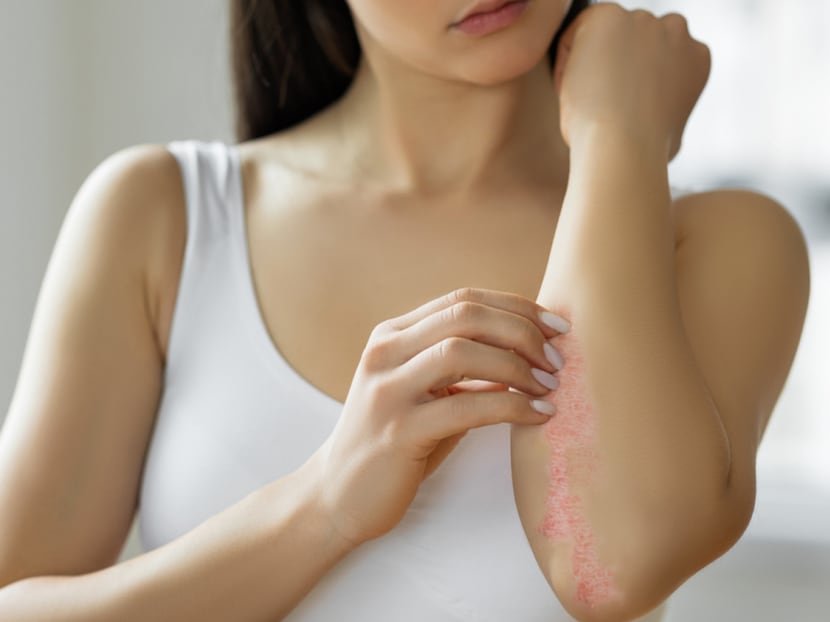
Psoriasis can appear on the joints such as the knees and elbows. (Photo: iStock/bymuratdeniz)


Mention “psoriasis” and many people would draw a blank or, at best, mistake it for eczema. And it is an easy mistake to make as the dry rashes of both skin conditions may appear similar.
But look closer and you’ll see that the affected area in psoriasis looks like the body is producing way too many skin layers, too soon. And you’d be right on that account. Normal skin cells take 20 to 30 days to mature and travel topside before they get shed, according to the Psoriasis Association of Singapore (PAS).
However, psoriatic skin cells take just three to eight days to make the journey. And it is this chaotic mix of live and dead skin cells sitting on the skin’s surface that creates the papery, silvery scales or skin plaques – the hallmarks of psoriasis.
Go beyond skin deep and another difference emerges: Eczema is likely caused by a weakened skin barrier owing to a gene mutation. Psoriasis, on the other hand, has been acknowledged by some experts as a chronic autoimmune skin disease, where the immune system mistakenly attacks normal cells of the skin and sometimes, the joints as well.
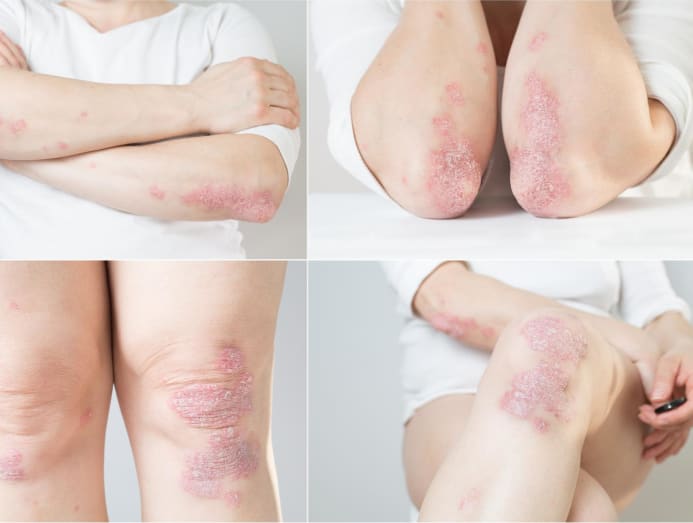
This skin condition affects about 1 per cent (one in 100) of the population. In Singapore, it is estimated that at least 40,000 persons have psoriasis, according to the PAS.
To set the record straight, psoriasis is not caused by poor personal hygiene, skin dryness – and is definitely not contagious or infectious.
HOW PSORIASIS MIGHT START AND ITS CAUSES
Psoriasis may begin as what seems like dandruff or skin flakes on your scalp. "Sometimes, it may look like other inflammatory skin rashes, including seborrhoeic dermatitis, eczema or fungal skin infections," said Dr Jamie Wee, a senior consultant and the head of Division of Dermatology, Department of Medicine at Ng Teng Fong General Hospital.
The factors that can exacerbate psoriasis include alcohol, smoking, stress, certain medications, infections such as bacterial throat infection, HIV as well as dry and cold weather, he said.
7 DIFFERENT TYPES OF PSORIASIS
1. Plaque psoriasis
This is the most common type of psoriasis. It creates dry, itchy, raised skin patches or plaques covered with scales. They usually appear on the elbows, knees, lower back and scalp.
2. Psoriatic arthritis
This form attacks both the skin and joints. There are five types of psoriatic arthritis and it’s possible to have more than one: Asymmetric psoriatic arthritis (limited to joints on one side of the body), symmetric psoriatic arthritis (strikes matching pairs of joints), distal psoriatic arthritis (affects fingertips and toes), spondylitis (affects the back) and arthritis mutilans (the rarest and most severe form that causes bone loss).
3. Nail psoriasis
It affects both fingernails and toenails. Nails will pit, and produce abnormal growth and discolouration. The nail may even loosen and separate from the nail bed. In severe cases, the nail may crumble.
4. Guttate psoriasis
This form is usually triggered by a bacterial infection such as strep throat. It's characterised by small scaley spots on the trunk, arms or legs.
5. Inverse psoriasis
It mainly affects the skin folds of the groin, buttocks and breasts. Instead of thick, raised patches, it causes smooth, inflamed skin that worsen with friction and sweat. Fungal infections may trigger this type of psoriasis.
6. Generalised pustular psoriasis
This is a rare type of psoriasis that creates pus-filled blisters. It can occur in widespread patches or on small areas of the palms or soles.
7. Erythrodermic psoriasis
The least common type, it can cover the entire body with a peeling rash that can itch or burn intensely. It can be acute or chronic.
Genetic predisposition is another key contributor, said Dr Liau Meiqi May, a consultant with Division of Dermatology, Department of Medicine at Alexandra Hospital and National University Hospital. She said that up to 30 per cent of individuals with psoriasis have family members with the disorder.
“Several genes have been identified that make one more susceptible to psoriasis, many of which are involved in the regulation of the immune system,” said Dr Liau. For instance, your chances of developing psoriasis are about 15 per cent if one of your parents has the condition. That risk goes up to about 50 per cent if both of your parents have it, she said.
Furthermore, psoriasis can begin at any age, though it is less common in children than adults. There are two age ranges that the chronic inflammatory skin condition can peak: Between 30 and 39 years old, and between 50 and 69 years old, said Dr Liau. However, “it is not exactly clear why the condition is more common in these two age groups”.
HOW DO PILLS AND INJECTIONS WORK ON CONTROLLING PSORIASIS?
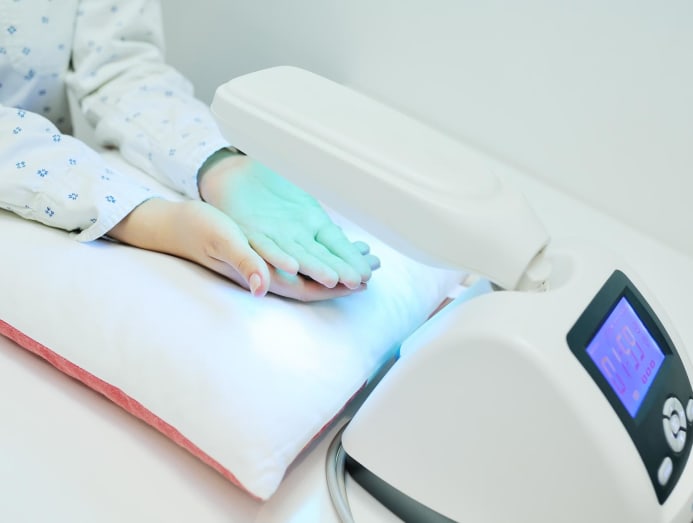
Most of the mild-to-moderate cases can be treated with phototherapy or topical medications. However, for patients with moderate to severe psoriasis, the dermatologist may prescribe systemic medications that treat the entire body, including the immune system. These treatments are usually administered via pills or injections.
Systemic medications affect the immune system in a few ways. They could suppress the immune system the way methotrexate and cyclosporine do to block inflammation. Or, they could normalise skin cell turnover rate the way acitretin works. These three oral medications are commonly prescribed in Singapore, according to Dr Colin Theng, PAS’s president and a dermatologist at The Skin Specialists & Laser Clinic.
Last December, the Health Sciences Authority (HSA) approved a fourth oral medication, apremilast, for use in Singapore, said Dr Theng. It works by reducing an enzyme (phosphodiesterase 4 or PDE4) in the immune system and skin cells that spurs the growth of skin plaques.
Despite their efficacy, systemic medications do have their drawbacks. Because they affect the whole body, there is a higher risk of serious side effects. Hence, lab tests and blood monitoring are required while on treatment with these medications, said Dr Hazel Oon, the chief of Psoriasis Unit and consultant-in-charge at the Acne Clinic, National Skin Centre.
Methotrexate, for example, relieves psoriasis on the skin as well as inhibits joint inflammation that causes arthritic joint damage. It sounds like a two-in-one heaven-send for those suffering from psoriatic arthritis.
However, methotrexate can also “affect the functioning of the liver and increase the likelihood of serious liver disease”, and cause miscarriages and serious birth defects during pregnancy, said Dr Eileen Tan, a dermatologist at Mount Elizabeth Novena Hospital’s Eileen Tan Skin Clinic & Associates.
Its side effects are so lasting that women who have taken methotrexate are strongly advised not to get pregnant six months after discontinuing it, said Dr Tan.

Biologics is another class of medications used for psoriasis that are derived from biological organisms such as humans, animals or micro-organisms. “Unlike many systemic drugs, biologics are more specific and they only target certain parts of the immune system,” said Dr Tan.
They work, she explained, by quietening a specific type of immune cell known as T-cell, which is known to be over-active in those with psoriasis. Other biologics block proteins known as cytokines that transmit inflammatory signals in the immune system.
Three types of cytokines – interleukin or IL 17, IL 12 and IL 23 – are commonly targeted for psoriasis. Depending on what cytokines they affect, said Dr Tan, biologics are classified into four broad categories: Tumour necrosis factor (TNF) inhibitors; IL inhibitors; B-cell inhibitors; and T-cell inhibitors.


WHY NOT GIVE EVERY PATIENT BIOLOGICS?
The prescription depends on the severity of the psoriasis, the patient’s age as well as the drug’s efficacy, sustained response, ease of use and ability to reach difficult-to-treat areas such as the scalp, nails, palms and soles, said Dr Oon.
“Some drugs target psoriatic arthritis as well, have better and faster skin clearance, and demonstrate better outcomes in more difficult-to-control psoriasis variants such as generalised pustular psoriasis,” she said. “The cost is also a very important deciding factor as psoriasis is a chronic disease and ongoing treatment is required to maintain disease control.”

Indeed, cost is a big consideration when it comes to using biologics, despite their targeted efficacy. “Biologics can range from several hundreds to over a thousand dollars a month,” said Dr Theng. “Comparatively, conventional oral medications can cost from less than a hundred to low hundreds.”
Furthermore, biologics don’t come in pills. They are usually in the form of pre-filled vials that patients self-inject using an autoinjector. “The frequency of the injections depends on the type of biologics used,” said Dr Theng. “They can range from two weekly injections to 12 weekly injections.”
For those reasons, Dr Theng estimated that about 10 per cent to 20 per cent of patients with moderate to severe psoriasis are on biologics.


WHAT NEW MEDICATION IS IN THE PIPELINE?
So, when a new oral medication’s promising trial results were announced at the latest World Congress of Dermatology (WCD) held in Singapore, it offers a potential alternative. The new drug by Janssen, the pharmaceutical arm of Johnson & Johnson, uses a new class of medication known as an antagonist peptide.
“It is not a biologic, meaning it’s not derived from human, animal or micro-organism,” said Professor Llyod Miller, its vice president of immune dermatology and disease.
The new therapy "has not been compared with current injectable treatments yet” but it works the same way as the biologics that target IL-23, he said – and in a more palatable pill form.
How long before patients can access it remains to be seen. “Once the drug gets approved by the relevant regulatory authorities such as the US Food and Drug Administration and European Medicines Agency, the approval in Singapore may take a further one to two years,” said Dr Theng. “But this is a rough estimate as some drugs may get expedited approval.”